

Filters
Acousticness
Acousticness is Spotify's score, from 0% to 100%, for how likely a track is to be acoustic: real instruments, little or no electronic amplification or production. The Acousticness filter keeps the tracks whose acousticness score sits inside a range you set. It is available on every plan.
What it matches
The higher the score, the more confident the analysis is that the track is acoustic.
The filter compares each track's score with your range and keeps the track when the score is inside it, both ends included.
High values are singer-songwriters, folk, classical and unplugged sessions. Low values are electronic music, heavily produced pop and most hip hop. A well-recorded acoustic guitar with a subtle synth pad behind it can land anywhere in the middle.
Famous songs and their scores
Press play to compare. Yesterday is a voice, an acoustic guitar and a string quartet, and scores 87%. Smells Like Teen Spirit, all distorted guitars, scores 0%.
Accept cookies to play these songs here.
Where the data comes from
The score is part of Spotify's audio analysis of the recording. Playlistation reads it from Spotify the first time a track is checked and stores it for later updates.
Spotify has no analysis for every track. When it has none, the track has no acousticness score and the filter treats it as not matching: the track stays out of the playlist whatever range you set.
Operators and values
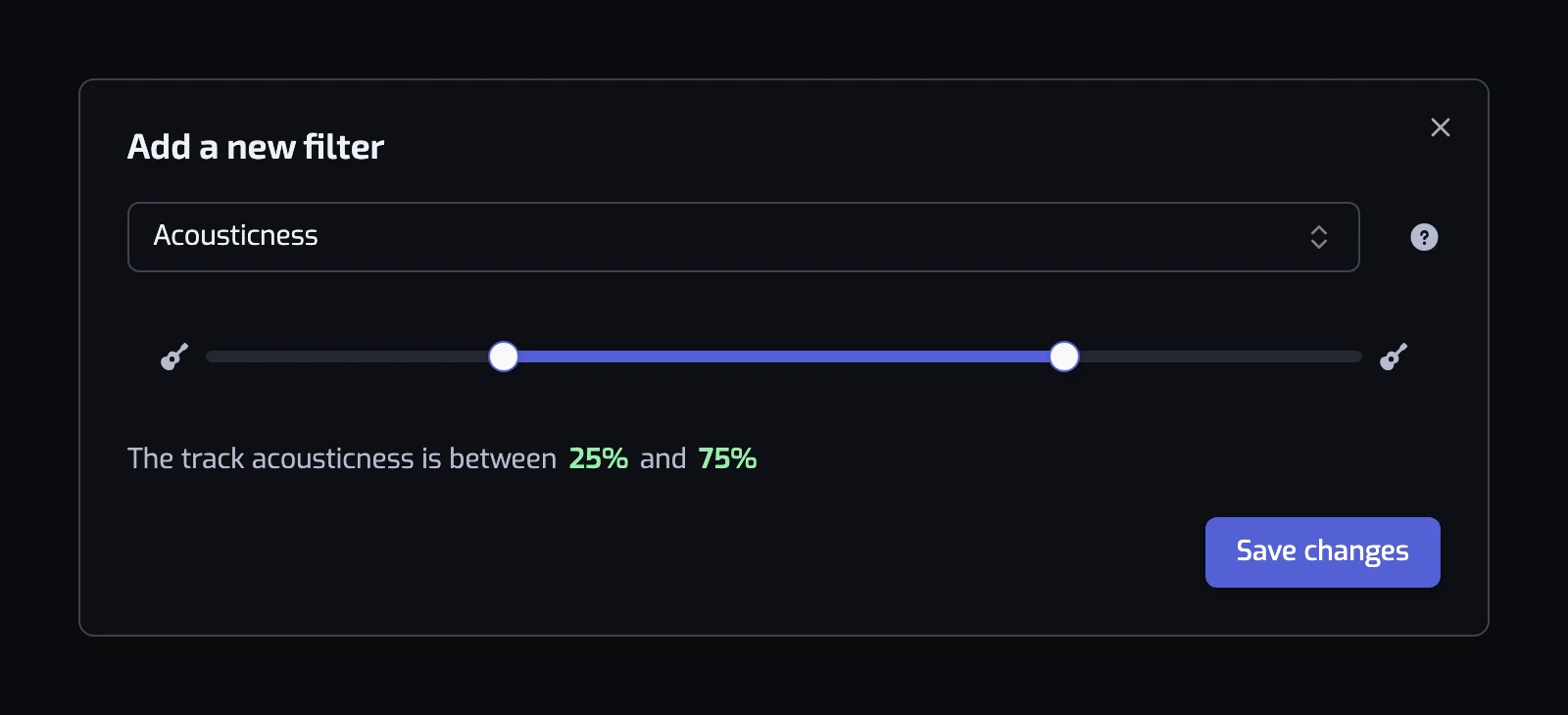
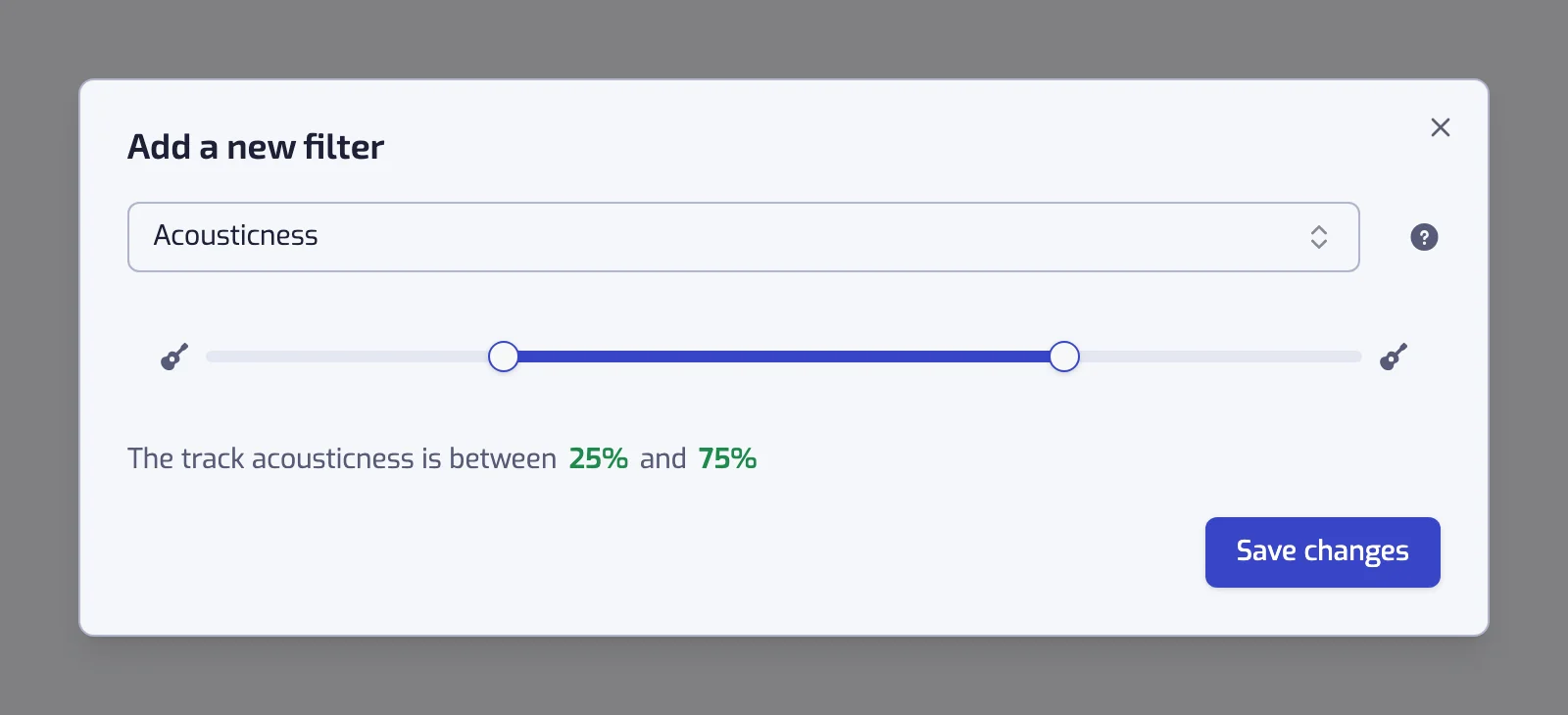
The filter has one operator, Between, so the dialog shows no operator card. You set a minimum and a maximum on a slider with two handles, from 0% to 100%, in steps of 5. A new Acousticness filter starts at 25% to 75%.
The sentence collapses at the ends of the scale:
- Minimum at 0: "The track acousticness is at most 15%".
- Maximum at 100: "The track acousticness is at least 60%".
- Anything else: "The track acousticness is between 25% and 75%".
A slider left at 0% to 100% shows the warning "With the current settings, all of the tracks will match this filter".
Examples
- The track acousticness is at least 60%. The acoustic playlist.
- The track acousticness is at most 15%. Fully electronic music, from the other end of the scale.
- The track acousticness is at least 60% and The track energy is at most 40% and The track instrumentalness is at most 50%. Quiet acoustic songs with vocals.
- The track acousticness is at least 50% and The track BPM is at most 90. Slow and acoustic, the wind-down playlist.
- The track acousticness is at least 70% and The track artist is tagged with one of jazz. Acoustic jazz without the fusion and the electric years.
Things to know
- It is a confidence, not a measurement. Two tracks that sound equally acoustic to you can score 55% and 85%. Expand a track in the track list at the bottom of the page: "The Acousticness score is 55%" shows you where the borderline songs land.
- Add Instrumentalness to separate acoustic songs from acoustic instrumentals such as classical guitar or solo piano.
- Live acoustic sessions often score high on both acousticness and liveness. The Liveness filter can pull them out on their own.
Common questions
What does acousticness mean in music?
Acousticness is Spotify's score, from 0% to 100%, for how confident its audio analysis is that a track is acoustic: real instruments, little or no electronic production. Folk, classical and unplugged sessions score high; electronic music and heavily produced pop score low.
Can a song with an acoustic guitar score low on acousticness?
Yes. The score is a confidence about the whole recording, not about one instrument: The Beatles' Here Comes The Sun opens on an acoustic guitar, with bass, drums and a Moog synthesizer behind it, and scores 3%. Check the borderline songs in the track list before you settle on a threshold.
Related filters
- Instrumentalness: vocals or none.
- Energy: acoustic tracks usually sit low on energy, but not always.
- Liveness: recorded in front of an audience.
- Combining filters