

Filters
Energy
Energy is Spotify's score, from 0% to 100%, for how intense and active a track sounds. The Energy filter keeps the tracks whose energy score sits inside a range you set. It is available on every plan.
What it matches
Loud, fast, busy tracks score high. Quiet, slow, sparse tracks score low. Spotify's own example: death metal scores high, a Bach prelude scores low.
The filter compares each track's score with your range and keeps the track when the score is inside it. Both ends count as inside: a track at exactly 70% matches a filter set to 70% or above.
It measures the sound, not the genre or the tempo. A quiet song by a loud band scores low. A slow, heavy rock track can still score high, because loudness and density count as much as speed.
Famous songs and their scores
Press play to compare. Time, from the Inception soundtrack, builds slowly and scores 9%. Billie Jean, a dance hit, scores 45%, because energy measures intensity, not groove. Smells Like Teen Spirit scores 91%.
Accept cookies to play these songs here.
Where the data comes from
The score is part of Spotify's audio analysis of the recording. Playlistation reads it from Spotify the first time a track is checked and stores it for later updates.
Spotify has no analysis for every track. When it has none, the track has no energy score and the filter treats it as not matching: the track stays out of the playlist whatever range you set.
Operators and values
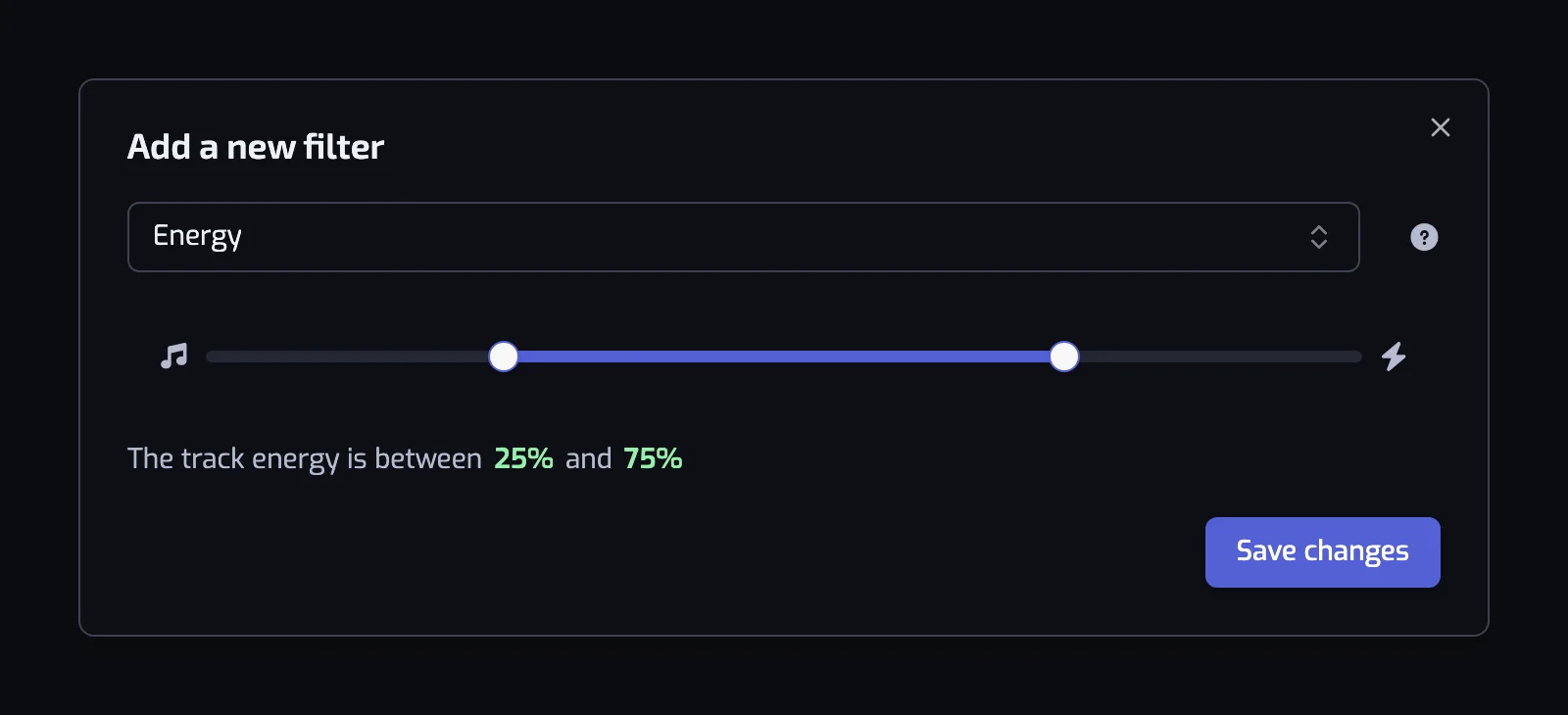
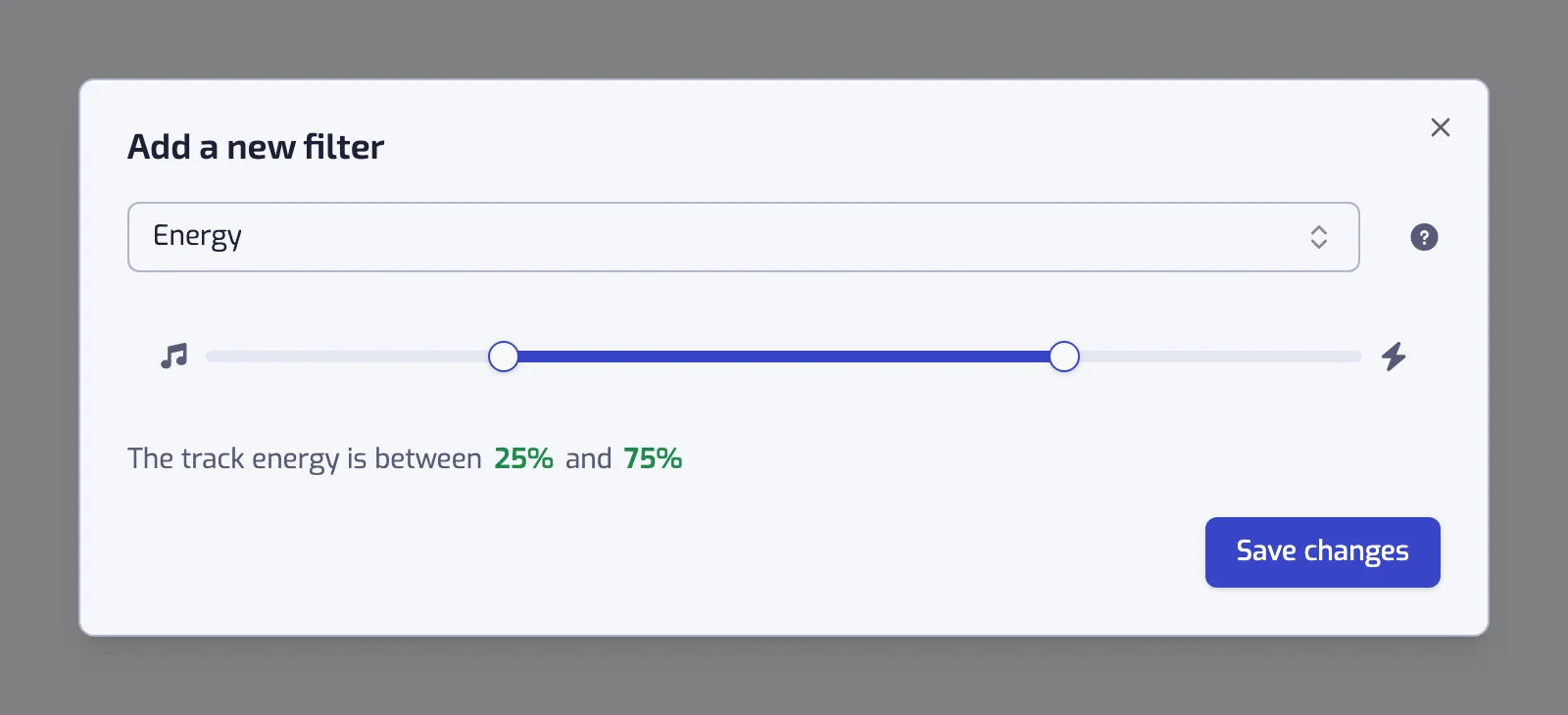
The filter has one operator, Between, so the dialog shows no operator card. You set a minimum and a maximum on a slider with two handles, from 0% to 100%, in steps of 5. A new Energy filter starts at 25% to 75%.
The sentence collapses at the ends of the scale:
- Minimum at 0: "The track energy is at most 40%".
- Maximum at 100: "The track energy is at least 70%".
- Anything else: "The track energy is between 25% and 75%".
A slider left at 0% to 100% shows the warning "With the current settings, all of the tracks will match this filter".
Examples
- The track energy is at least 70%. The workout playlist, whatever the genre.
- The track energy is at most 35%. Quiet music for reading or falling asleep.
- The track energy is between 40% and 70% and Liked date: In the last 90 days. Recent likes that work as background music at dinner.
- The track energy is at least 60% and The track BPM is between 156 and 176. Fast and intense, for running.
Things to know
- The thresholds are personal. Build the playlist, then expand a track in the track list at the bottom of the page: "The Energy score is 63%" shows where the songs at the edge of your range land, so you can move the handles.
- Energy and Tempo together are more useful than either alone: fast and energetic is the gym, slow and energetic is heavy rock, fast and calm is a lot of folk.
- An empty Energy line in the track list means Spotify has no analysis for that track, so it never matches.
Common questions
What is Spotify's energy score?
Energy is Spotify's score, from 0% to 100%, for how intense and active a track sounds: loud, fast, busy tracks score high, and quiet, sparse ones score low. It measures the sound, so a slow, heavy rock track can still score high while a quiet song by a loud band scores low.
Why does a dance hit score low on energy?
Energy measures how intense, loud and busy a track sounds, not how much it makes you move. Michael Jackson's Billie Jean scores 45% on energy and 93% on danceability. For a party playlist, filter on Danceability first and use Energy to leave out the quietest tracks.
Related filters
- Tempo (BPM): speed, which energy does not measure.
- Danceability: steady, danceable rhythm rather than intensity.
- Positiveness: happy or sad, on a different axis from loud or quiet.
- Acousticness: acoustic tracks usually sit low on energy.
- Combining filters